Brief History of Kazan
Foundation of Kazan and its early history
Kazan was founded more than 1,000 years ago as an outpost on the northern borders of the Volga Bulgaria - a historic Bulgar state in the Middle Volga region and the Kama River basin, which existed from the 7th to 13th centuries. The age of Kazan was determined during excavations on the territory of the Kazan Kremlin, when a Czech coin dated 929-930 was found here, as well as the remains of masonry, a wooden fence, utensils.
In the 1220s-1240s, the Volga Bulgaria was conquered by the Mongols and, retaining some autonomy, was included in the Ulus of Jochi also known as the Golden Horde. After the formation of the Golden Horde, the Volga Bulgarians (Bulgars) became one of the main components in the ethnogenesis of today’s Kazan Tatars and Chuvashs.
In the 13th-14th centuries, Kazan became an important trade and political center of the Golden Horde. The growth of the town was also due to its favorable geographical position at the intersection of major trade routes connecting East and West. In the Russian chronicles, Kazan began to be mentioned in the 14th-15th centuries.
In 1438, the Bulgarian fortress of Kazan was captured by the Golden Horde khan Ulugh Muhammad, and the town became the capital of the Kazan Khanate. During this period, the production of leather goods, pottery, and weapons developed here. Kazan traded with Moscow, Crimea, the Ottoman Empire, and other regions.
More Historical Facts…
A series of conflicts with the Principality of Moscow eventually led to the capture of Kazan by the army of Ivan the Terrible in 1552. After the suppression of the uprisings in the Kazan region, a new era began in the history of the town - as part of the Russian state. In the 17th century, the first manufactories appeared in Kazan. In 1646, there were 5,432 men and 1,652 households in the town.
Kazan as part of the Russian Empire
In 1708, Kazan became the capital of the vast Kazan Governorate. During the reign of Peter the Great, it became one of the most important industrial and administrative centers of Russia. A tannery and a cloth manufactory were built here. In 1722, Peter the Great visited Kazan.
The rapid development of Kazan began after the visit of Empress Catherine II in 1767, when she lifted all previous restrictions on the construction of stone mosques and Tatar public buildings, as well as in connection with her decree “On the tolerance of all faiths.” She presented Kazan with a galley and a carriage. The galley was lost during a fire, but the carriage was preserved. It is also installed as a replica-monument on the pedestrian Bauman Street.
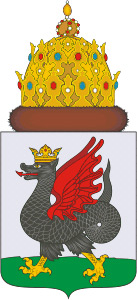
In 1781, Catherine II approved the emblem of Kazan, in 1782 - the first regular development plan for the city, which determined its development for a century and a half. By the end of the 18th century, about 22 thousand people lived in Kazan, more than 40 thousand with nearby settlements, Tatars made up only about 10% of the population.
In 1804, Imperial Kazan University was opened, the most famous students of which are Vladimir Lenin and Leo Tolstoy. In 1844, Karl Ernst Claus, professor at Kazan University, discovered ruthenium and named it in honor of Russia. Ruthenium is the only chemical element discovered in the Russian Empire and the USSR before the synthesis of transuranium elements in the late 20th century.
In the second half of the 19th century, significant changes took place in the infrastructure of Kazan: gas (1874) and electric (1897) lighting, one of the first electric trams (1899), telegraph (1859) and telephone (1881). In 1874, the city water supply was opened. In 1896, the railway connected Kazan with Moscow.
Kazan in the 20th century and beyond
In 1901, the Kazan Observatory was opened. In 1914, the population of Kazan was about 194,200 people. In 1918, during the Civil War in Russia, fierce battles were fought for Kazan. The troops of the Czechoslovak Legion in the course of five-day battles captured Kazan on August 6. The Red Army established control of the city on September 10.
On May 27, 1920, the Tatar Autonomous Soviet Socialist Republic was formed with its capital in Kazan. In the 1930s, intensive industrialization of the city began, accompanied by rapid population growth. In 1939, the population of Kazan was 398,014 people.
During the Second World War, large factories were evacuated to Kazan. The city also became the temporary scientific “capital” of the USSR. The Academy of Sciences of the USSR, as well as most of the research institutes and a number of design bureaus were evacuated here.
After the war, the active development of the city continued. Kazan became one of the largest industrial, scientific, and cultural centers of the USSR, the population increased 2.5 times. In 1979, it exceeded 1 million people. Kazan also became one of the largest river ports, a new airport was built.
In 1990, Kazan was declared the capital of the sovereign Republic of Tatarstan. In the 1990s, this city became one of the most important interregional political, financial, sports, and tourist centers of Russia. In 2008, Kazan registered the brand “The Third Capital of Russia.”
In the 1990s-2000s, the historic center of Kazan was significantly rebuilt in preparation for the celebration of the millennium of the city. In 2005, the Millennium of Kazan was celebrated. In connection with this event, such objects as the Kazan Metro, the Kul-Sharif Mosque, the Millennium Bridge, the new hippodrome, Tatneft-Arena were built.
About one million tourists a year began to visit Kazan making it one of the most important tourist centers in Russia. The Kazan Kremlin became a UNESCO World Heritage Site. Several foreign general consulates and other diplomatic, trade, humanitarian representations were opened in the city.
Such large international sports competitions as the World Summer Universiade 2013, the World Aquatics Championship 2015, and six matches of the 2018 World Cup were held in Kazan.
Contrasts of Kazan
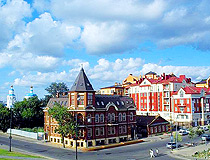
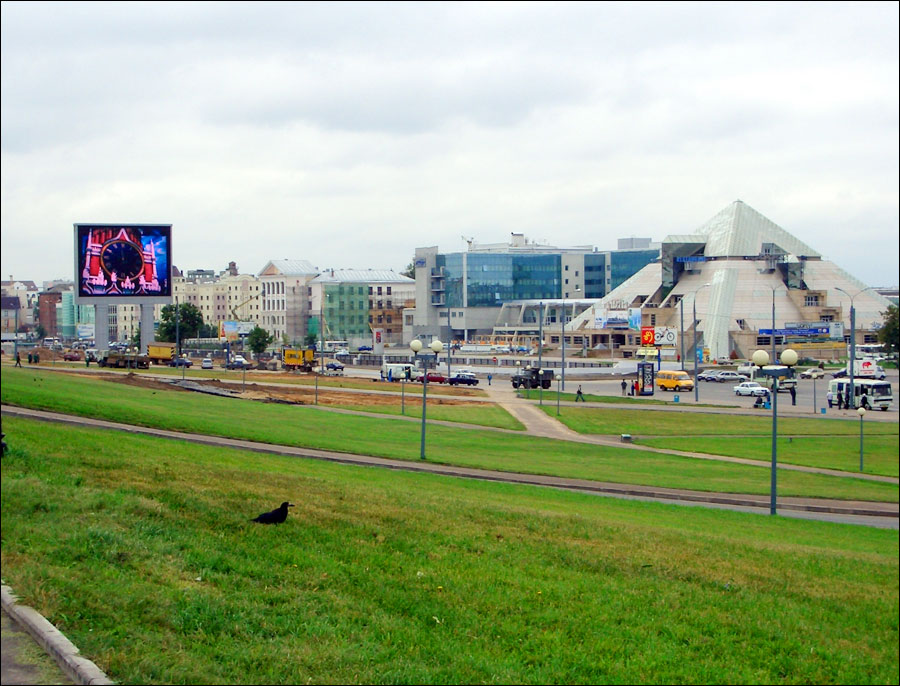
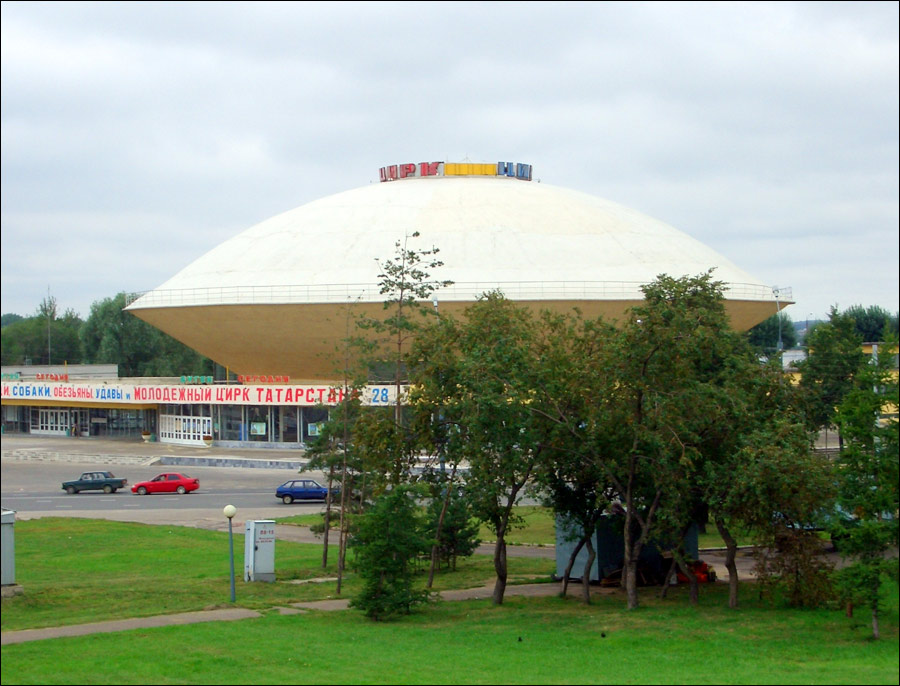
In the center of Kazan
Author: Sergey Bulanov
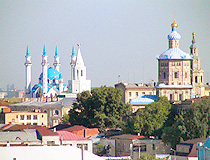
Kul-Sharif Mosque and Saints Peter and Paul Cathedral in Kazan
Author: Ayhan Sahin
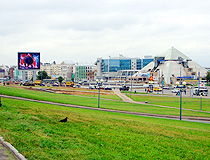
The cultural-entertaining complex Pyramid in Kazan
Author: Sergey Kozin
Kazan - Features
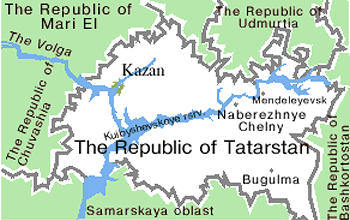
The Kazanka River flows from the north-east to the west through the middle of the city and divides Kazan into two parts - the historic part to the south of the river and the new part to the north. They are connected by five dams and bridges, as well as a metro line.
The climate of Kazan is temperate continental, severe frosts and scorching heat are rare and not typical for this city. The average temperature in January is minus 10.4 degrees Celsius, in July - plus 20.2 degrees Celsius.
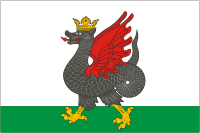
There are several legends associated with the name of the city. According to the most common one, it originates from the Tatar word “kazan” meaning “cauldron”. The legend says that Kazan was founded on the spot where water boiled in a cauldron dug into the ground without fire. The historical symbol of Kazan, which is depicted on the emblem of the city, is the mythical dragon-like creature Zilant often mentioned in Tatar legends.
The industrial basis of Kazan includes engineering, chemical and petrochemical industries, light and food industries. The largest enterprises of Kazan are the chemical complex of Kazanorgsintez, the Kazan gunpowder factory (the oldest in Russia), and a unique cluster of three aviation industry enterprises. Tourism is also one of the promising directions for the development of the city. In 2019, about 3.5 million tourists visited Kazan.
This is one of the largest transport and logistics hubs in Russia. Kazan International Airport offers regular flights to such cities as Antalya, Baku, Barcelona, Yekaterinburg, Krasnodar, Moscow, Omsk, Perm, Thessaloniki, St. Petersburg, Sochi, and a number of others. Kazan (Volga) Federal University is one of ten Russian federal universities and the third (after St. Petersburg State University and Moscow State University) oldest university in Russia.
Kazan is a place where people of different nationalities and religions live peacefully, in an atmosphere of friendliness and tolerance. In this city, two religions are historically closely intertwined: Sunni Islam and Orthodoxy. Kazan has more than 60 mosques, 40 Orthodox churches, a dozen churches of other Christian movements, 1 synagogue, prayer houses of Bahai and Krishna.
In total, representatives of over 115 nationalities live in the capital of Tatarstan. According to the 2010 census, the most numerous of them are Russians (48.6%) and Tatars (47.6%). Also among the residents of Kazan you can meet the Chuvash, Ukrainians, Mari, Bashkirs, and Udmurts.
Main Attractions of Kazan
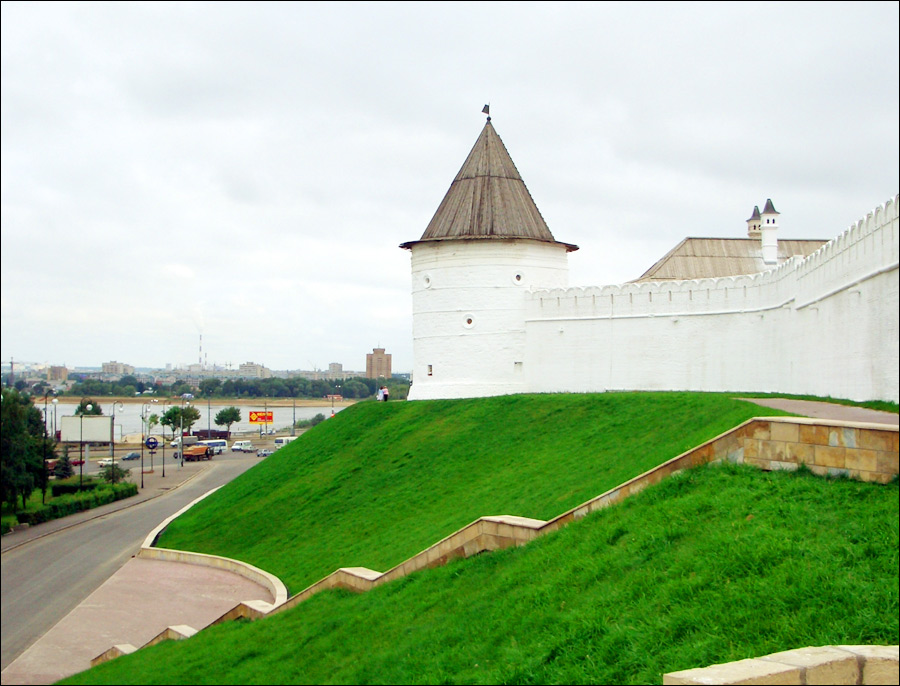
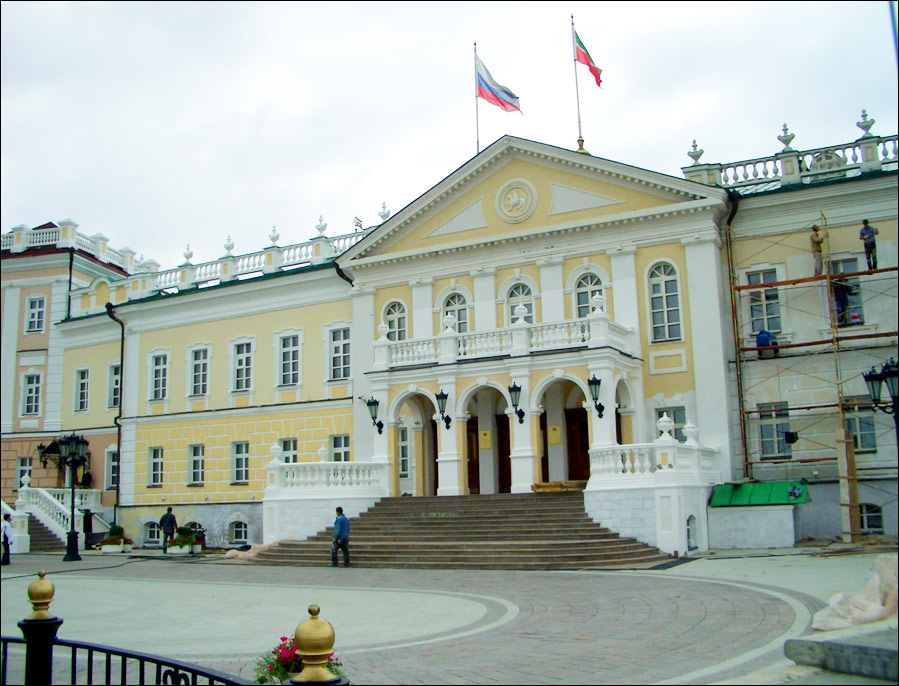
The Kazan Kremlin - the oldest part of Kazan included in the list of UNESCO World Heritage Sites. It is a complex of architectural, historical, and archaeological monuments of the 12th-20th centuries. On the territory of the Kazan Kremlin, eastern and western cultures are harmoniously intertwined. The residence of the Head of the Republic of Tatarstan and the Government of Tatarstan are located here.
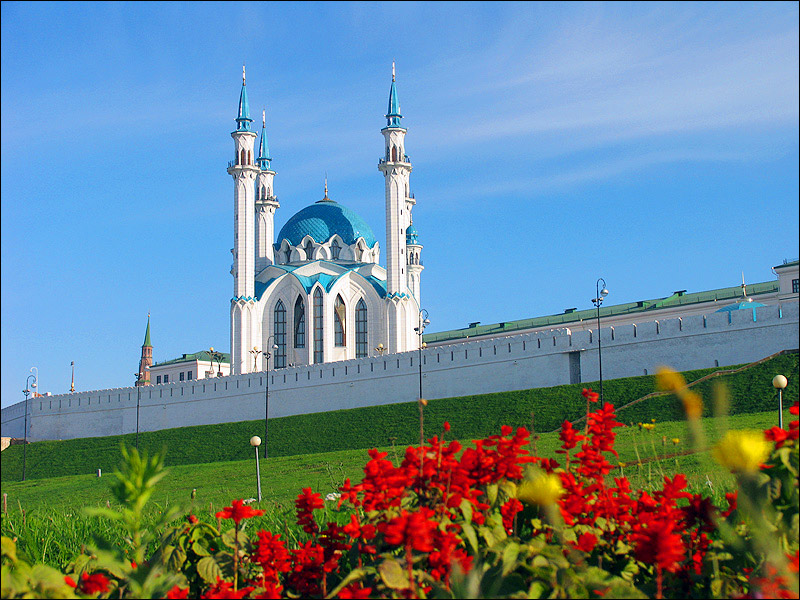
Kul-Sharif Mosque (1996-2005) - the main mosque of Tatarstan located on the territory of the Kazan Kremlin. This is an amazing building with four minarets, each 58 meters high, with stained glass windows and observation towers. The mosque has a museum of Islam, as well as observation balconies for tourists.
The Annunciation Cathedral (1555-1562) - the oldest building of the Kazan Kremlin. This outstanding monument of Russian architecture of the 16th century is the most remote example of the Pskov school of architecture.
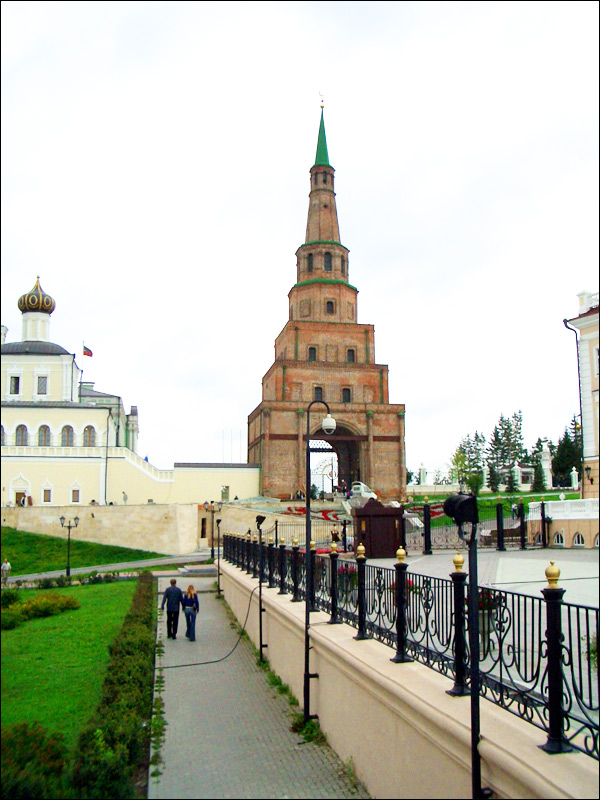
Syuyumbike Tower - an old watch tower in the Kazan Kremlin, one of the main architectural symbols of Kazan. It belongs to the “falling” towers, as it has a noticeable slope to its northeastern side. Today, the deviation of its spire from the vertical is about 2 meters.
The Museum of Natural History of Tatarstan in the Kazan Kremlin - the only museum and scientific-educational center in the Volga region, which provides complete information about the geological history of our planet from the moment of its formation until the appearance of the first ancient people. The combination of traditional forms of presentation with interactive elements makes this museum attractive to a wide range of visitors.
The Hermitage-Kazan Exhibition Center in the Kazan Kremlin - the first regional branch of the State Hermitage (the second largest art museum in the world located in St. Petersburg). In the museum halls you can see paintings, graphics, ancient artifacts including household items made of gold and silver, weapons of the 8th-13th centuries, various archaeological artifacts, and modern art installations.
Bauman Street (Kazan Arbat) - the main pedestrian street of Kazan, about 4 km long. The street starts at the Kazan Kremlin and stretches through the city center. On this street you can see a lot of historical buildings, monuments, museums, a theater, countless cafes where you can taste national dishes and drinks, souvenir shops.
Epiphany Cathedral (1731-1756) on Bauman Street. The main attraction of this church is its magnificent tall bell tower (74 meters high) built in the style of “Russian Baroque” with numerous external decorative elements.
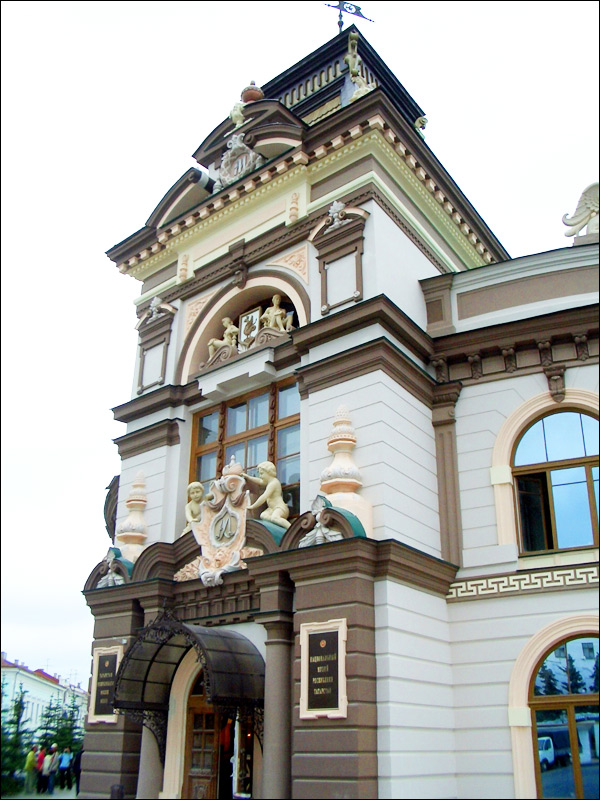
The National Museum of the Republic of Tatarstan - the main museum of Tatarstan opened in 1895, one of the largest museums in the entire Volga region. In total, this museum has about 800 thousand exhibits that tell about the culture, history, life, traditions of the peoples of Tatarstan. The museum occupies a building, which is a monument of architecture and history of federal significance. Kremlyovskaya Street, 2.
The Museum of Fine Arts of the Republic of Tatarstan - one of the largest art museums in Russia. Here you can see paintings, graphics, sculptures, works of decorative art of Western European and Russian schools of the 16th-19th centuries, as well as Soviet art. An important place in the exposition is occupied by a collection of icons from Sviyazhsk cathedrals and a unique collection of paintings by Nikolai Ivanovich Feshin - a master of impressionism and modernism. Karla Marksa Street, 64.
The Old Tatar Sloboda - one of the historic districts of Kazan. Its pedestrian part stretches for half a kilometer from Bauman Street and occupies part of Kayuma Nasyri Street. The district was formed in the 17th-18th centuries, when picturesque houses, mosques, and other attributes of the Tatar culture were built here. In Soviet times, most of them were lost. In the 2000s, it was reconstructed to give it its former splendor.
Shamil’s House - an eclectic building located in the Old Tatar Sloboda, an architectural monument and an object of cultural heritage of regional significance. Today, it houses the Literary Museum of Gabdulla Tukay. Gabdully Tukaya Street, 74.
Chak-Chak Museum. This museum located in the Old Tatar Sloboda is dedicated to the main Tatar dessert and one of the symbols of Tatarstan. The atmosphere of the Tatar prosperous house of the late 19th century is recreated here (old furniture, household utensils, tools, etc.). The exposition tells about the history of chak-chak from the times of the Volga Bulgaria to the present. Parizhskoy Kommuny Street, 18.
Saints Peter and Paul Cathedral (1723-1726) - an architectural monument built in the style of “Russian Baroque”. It is known for its 7-tier gilded iconostasis and rich history. Musy Dzhalilya Street, 21.
The Temple of All Religions. This unusual architectural structure dedicated to various religions of the world is also known as the Ecumenical Church and the International Cultural Center for Spiritual Unity. This is the only such building in the world on the territory of which 16 faiths are united, but no religious rites are held here, since the complex has only symbolic meaning. Staro-Arakchinskaya Street, 4.
The Palace of Farmers (2008-2010) - a palace complex built in the Empire and Classicism styles. The Ministry of Agriculture of Tatarstan is located here. The main decoration of this magnificent building is a huge bronze tree placed inside an arch. At night, the facade of the palace is illuminated. Fedoseyevskaya Street, 36.
The Family Center “Kazan” (2013). This original building serves as the Wedding Palace of Kazan. Inside, there are three thematic zones, which are decorated and furnished in the styles of the Volga Bulgaria, the Kazan Khanate, and in a classical manner. The top of the building is crowned with a huge Turkic cauldron (“kazan”). In the days free from wedding registration, tourists can visit this building and climb to the observation deck. Sibgat Khakim Street, 4.
The Island-Town of Sviyazhsk - a historic town founded on an island at the confluence of the Sviyaga into the Volga in 1551. Located about 64 km west of Kazan, it is a very unusual and incredibly picturesque place.












The comments of our visitors