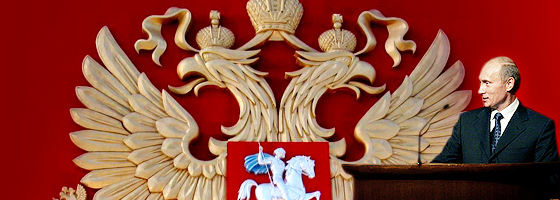
The Constitution of Russia
The state system of the Russian Federation is defined by the Constitution adopted by the popular vote on December 12, 1993.
Article 3 of the Constitution states that the only source of power in Russia is its multinational people. The people exercise their power directly, as well as through state authorities and local self-government bodies.
According to Article 7, Russia is a social state, which policy is aimed at creating conditions that ensure a decent life and free development of a person.
The Constitution of the Russian Federation
Article 10 of the Constitution establishes that state power in the Russian Federation is exercised on the basis of a division into the legislative, executive and judicial branches. Legislative, executive and judicial authorities are independent.
According to Article 11, the subjects of state power are:
- The President of the Russian Federation,
- The Federal Assembly (the Federation Council and the State Duma),
- The Government of the Russian Federation,
- Courts of the Russian Federation.
Article 13 of the Constitution says that political and ideological diversity, multi-party system, equality of public associations before the law are recognized in Russia. No ideology can be established as a state or mandatory.
As of February 2017, 77 parties were registered in Russia, 14 of them participated in the elections to the State Duma of the Federal Assembly of the Russian Federation in 2016.
In Article 14, Russia is designated as a secular state, no religion can be established as a state or compulsory, and religious associations are separated from the state and are equal before the law.
The President of Russia
The head of the Russian state is the President of the Russian Federation who:
- is the guarantor of the Constitution, the rights and freedoms of citizens,
- takes measures to protect the sovereignty of Russia, its independence and state integrity,
- ensures coordinated functioning and interaction of public authorities,
- determines the main directions of domestic and foreign policy of the state.
The President is elected on the basis of universal, equal and direct suffrage by secret ballot. The same person can not hold the office of the President for more than two consecutive terms. On the basis of amendments to the Constitution, which entered into force on December 31, 2008, starting with the 2012 elections, the President is elected for a six-year term of office.
The real situation differs significantly from that stated in the Constitution. Russia is in fact a presidential unitary state in which there is no real separation of powers. The parliament plays a decorative function, courts are not independent. There is tight control over the political sphere, access of opposition parties to elections and to the media is very limited.