History of Tomsk
Foundation of Tomsk
According to a large number of archaeological finds, people lived on the territory of today’s Tomsk long before its foundation. At the end of the 16th century, by the time the Russians began to actively explore this region, Siberian Tatars and nomadic peoples at war with them lived here.
In January 1604, a delegation headed by Toyan, the prince of the Eushta Tatars, came to Moscow to the Russian Tsar Boris Godunov with a request to accept them into Russia and to protect them from the attacks of warlike neighbors - the Yenisei Kyrgyz and Kalmyks. In response, Boris Godunov signed a charter on the construction of a town on the lands of the Eushta people on the banks of the Tom River.
In June 1604, the fortress of Tomsk was founded on the southern promontory of Voskresenskaya Mountain towering over the right bank of the Tom. Therefore, the City Day of Tomsk is celebrated on June 7th. In the fall of 1604, all construction work was completed. Tomsk became an important strategic military center. Throughout the 17th century, it protected the local population - in 1614, 1617, 1657, and 1698, the fortress repelled the raids of nomads. In 1635, the population of Tomsk was about 2 thousand people.
More Historical Facts…
Tomsk in the 18th - early 20th centuries
In the 18th century, the borders of Russia moved far to the south and east, the raids of nomads stopped, and Tomsk lost its defensive significance. In 1723, about 8.5 thousand people lived in the town. From the middle of the 18th century, due to its remoteness from the European part of the country, it was used as a place of exile. After the creation of the Siberian Route, which ran from Moscow through Tomsk, the town became an important transit trade center.
In 1804, Tomsk became the administrative center of the huge Tomsk Governorate, which included the territories of the present Republic of Altai, Altai Krai, Kemerovo, Novosibirsk, and Tomsk Oblasts, East Kazakhstan Oblast (Kazakhstan), western parts of Khakassia, and Krasnoyarsk Krai. It also became the cultural and economic center of the south of Western Siberia.
From the late 1830s to the middle of the century, the population of Tomsk grew rapidly thanks to the increasing gold mining in Siberia. In 1888, Tomsk University was opened - the first university in Siberia. At the end of the 19th century, during the construction of the Trans-Siberian Railway, it was decided that it should go much south of Tomsk. As a result, it lost its importance as a transport hub.
By the beginning of the 20th century, over 60 thousand people lived in Tomsk. The city had electric lighting, trams, and a telephone network. By 1914, Tomsk, with a population of 114 thousand people, was among the 25 largest cities of the Russian Empire and ranked first in terms of trade turnover in Siberia.
Tomsk after 1917
After the revolutionary events of 1917, Tomsk became a center for the opposition to the Bolshevik forces in Siberia. Until the end of 1919, the city served as a place for the formation and training of units of the White Army.
The period from 1918 to 1940 was a time of relative decline in Tomsk. There was a significant outflow of the population to the fast-growing Novosibirsk and other cities located on the Trans-Siberian Railway, because Tomsk lost the status of the administrative center of the region. In 1925, Tomsk became part of Siberian Krai. In 1930, it was transformed into West Siberian Krai. In 1937, Tomsk became a city of Novosibirsk Oblast.
During the Second World War, about 30 enterprises from the European part of the USSR were evacuated to Tomsk, which became the basis of the city’s industry. During the war years, the volume of industrial production in Tomsk tripled. From 1940 to 1944, the number of residents increased from 145 to 178 thousand people. On August 13, 1944, Tomsk Oblast was formed, and Tomsk became its administrative center.
In the post-war years, new industries appeared in Tomsk - optical-mechanical, electrical, mechanical rubber. Metalworking and mechanical engineering, food and light industries grew significantly. The development of the city and the region was also largely connected with the beginning of the industrial development of oil and natural gas fields.
In 1970, Tomsk, which had a large number of preserved monuments of wooden architecture of the 19th century, was given the status of a historical city. In 1989, the population of Tomsk exceeded half a million people.
In the 1990s, in Tomsk, as in most cities in Russia, there was a decline in industrial production, especially in mechanical engineering focused on military government orders. In 2004, Tomsk celebrated its 400th anniversary.
Pictures of Tomsk
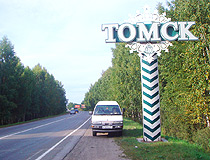
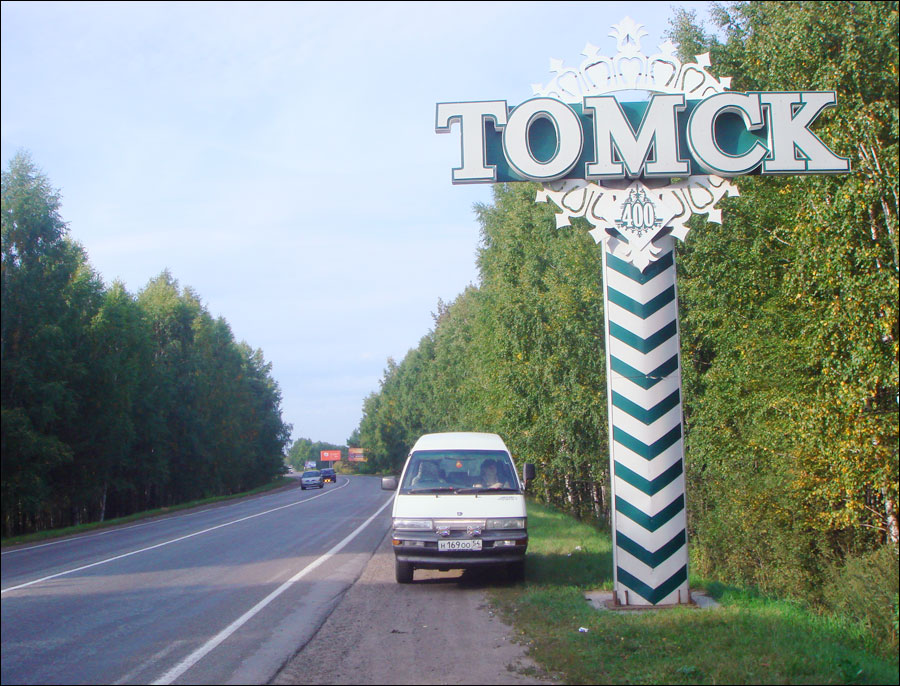
Tomsk entrance sign
Author: Tsigankov Konstantin
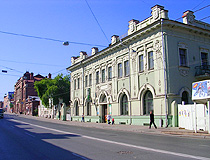
On the street in the historical center of Tomsk
Author: Vladimir Kharitonov
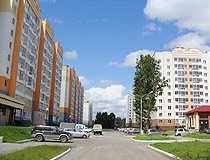
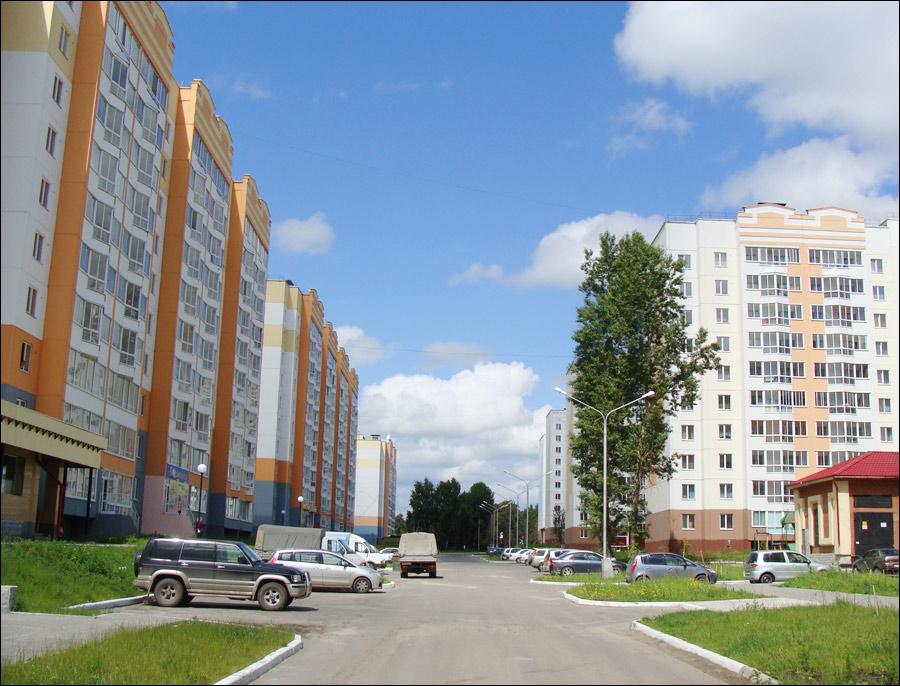
In the residential area of Tomsk
Author: Dmitry Afonin
Tomsk - Features
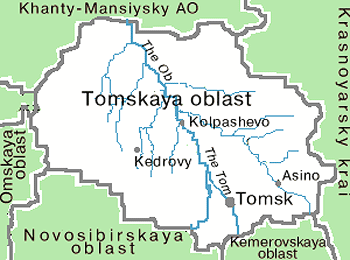
Tomsk is located in the very heart of Siberia, about 3.6 thousand kilometers east of Moscow, on the border of the West Siberian Plain and the spurs of the Kuznetsk Alatau on the right bank of the Tom River, 50 km from the place of its confluence with the Ob River. The city is located on the edge of a taiga natural zone.
It was named after the Tom River on which it was founded. The researchers of the 18th century derived the hydronym “Tom” from the Ket word “tom” meaning “river”. The City Day of Tomsk is celebrated on June 7.
The climate in Tomsk is continental-cyclonic (transitional from European temperate continental to Siberian sharply continental). Winter is harsh and long, the average temperature in January is minus 17.1 degrees Celsius, in July - plus 18.7 degrees Celsius.
The international airport Tomsk (Bogashevo) named after Nikolai Kamov offers regular flights to Moscow, St. Petersburg, Yekaterinburg, Surgut, Krasnoyarsk, Barnaul, Ulan-Ude, Ufa, Nizhnevartovsk, and a number of other Russian cities.
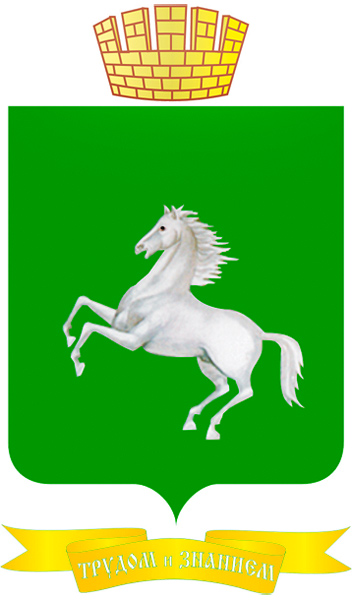
The current coat of arms of Tomsk is based on the coat of arms adopted in 1785. The silver horse was placed on the coat of arms as a sign that “the horses of this area are the best and the Tatars living nearby have stud farms”. The silver horse remains the symbol of Tomsk to this day.
Tomsk is the oldest educational and scientific center in Siberia. Today, students make up one fifth of the population of Tomsk - more than 117 thousand people.
Wooden architecture of Siberia is a bright page in the history of Russian architecture. In Tomsk, wooden architecture is original and expressive. It is here that whole groups of wooden buildings of the late 19th - early 20th centuries have been preserved. You will need at least three days to explore the large number of local attractions.
Main Attractions of Tomsk
Voskresenskaya Gora (Mountain) - the place where Tomsk was founded. Here you can see such sights of Tomsk as Beloye (White) Lake, Voskresenskaya (Resurrection) Church built in the rare Siberian Baroque style in 1789-1807, the Makushin House of Science - an architectural monument of the early 20th century, which houses the puppet theater “Skomorokh”, the Polish Church (1833). The best view of the surroundings opens from the Museum of the History of Tomsk.
Museum of the History of Tomsk. The building of this museum stands out for its unordinary architecture - a stone building crowned by a wooden observation tower, which you can climb and see Tomsk from above. Here you can find exhibitions about peasant and merchant life, a collection of porcelain, and other interesting historical and archaeological exhibits. One of the most interesting exhibits is a wooden monument to the Russian ruble - a copy of a 1 ruble coin, but 100 times larger than the original. Bakunin Street, 3.
Lagernyy Sad (Camps Garden) - a park with an area of about 40 hectares located on the right bank of the Tom River. Several thousand years ago, ancient settlements were located on this very place. The park got its name due to the fact that the summer camps of the Tomsk infantry regiment were located here in the 18th-19th centuries. Today, it is a huge green area with a large population of animals and birds.
Novo-Sobornaya Square - the central square of Tomsk. The architectural appearance of this square began to take shape in the 1840s. In 2003, the square was decorated with a fountain, in 2004 - a monument to the students of Tomsk, and in 2006— the Victory Alley memorial complex.
Tomsk Regional Museum of Local Lore - the largest museum in Tomsk Oblast with more than 140 thousand exhibits. The museum occupies an Empire style mansion of the 19th century and is dedicated to the history and culture of the Tomsk region. Among the most interesting collections are bronze items of the 5th-2nd centuries BC, old handwritten books, Russian silver coins, ceramics, furniture, personal funds of major researchers and architects. A tour of the museum can take several hours. Lenin Avenue, 75.
Tomsk Regional Art Museum. It is housed in a magnificent red brick and sandstone mansion built in 1903. This museum has an excellent collection of paintings, graphics, sculpture, arts and crafts, and icons. The exhibition includes canvases created by European painters of the 16th-21st centuries, Russian and Soviet artists of the 18th-21st centuries. Nakhanovich Lane, 3.
Architecture of Tomsk
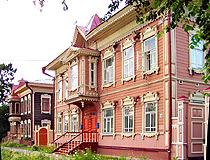
Beautiful wooden buildings of Tomsk
Author: S. Shugarov
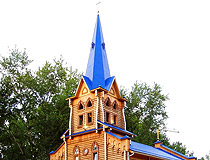
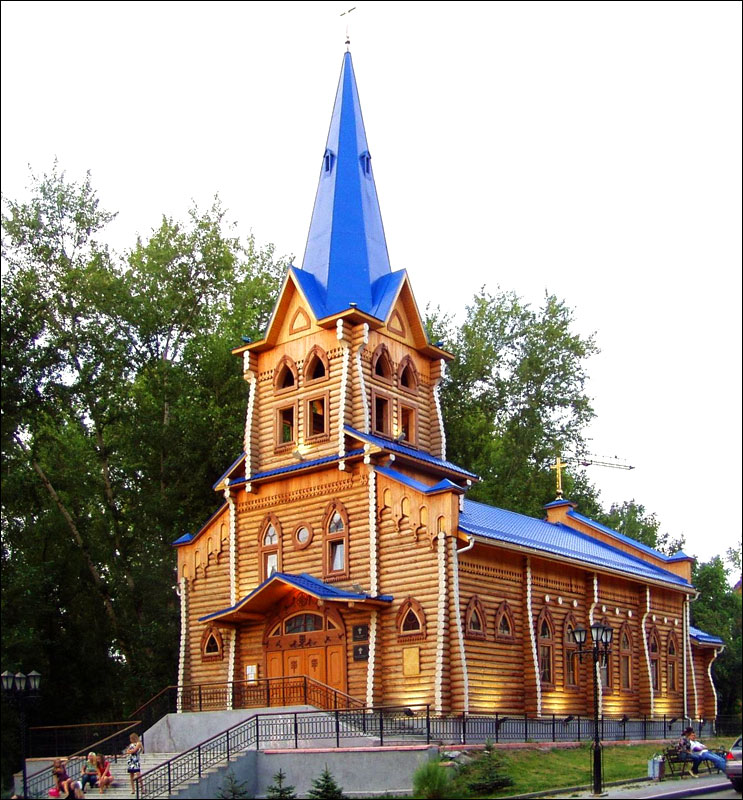
Wooden Lutheran Church of St. Mary in Tomsk
Author: S. Shugarov
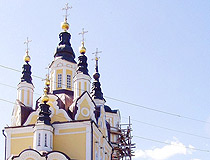
Church of the Resurrection in Tomsk
Author: S. Shugarov
Museum of Wooden Architecture. The exposition of this museum is devoted to the main periods in the history of Tomsk wooden architecture. The building of the museum is an architectural monument of federal significance. The main exhibits are wooden fragments of houses (window frames, cornices, pilasters, examples of carved decor). Dozens of contemporary craftsmen showcase their talents in artistic woodworking in a separate hall. Kirov Street, 7.
The First Museum of Slavic Mythology. This museum offers a look at the origins of the Slavic religion - or rather, what was before the arrival of Orthodoxy. The museum collection is dedicated to Slavic epics, folk tales, and their heroes. Zagornaya Street, 12.
“The NKVD Investigative Prison” - a memorial museum located in the basement of the former NKVD prison. It is dedicated to the memory of people who suffered from repression during the Soviet era. The complex consists of the Square of Memory and the exhibition itself. The permanent exhibition is housed in a makeshift prison hall, cells, and the investigator’s office. The collection consists of documentary materials, photographs, handicrafts of prisoners, and their personal belongings. Lenin Avenue, 44.
Monument to Anton Chekhov - an unusual sculpture standing on the embankment of the Tom River opposite the restaurant “Slavyansky Bazar” (the oldest restaurant and one of the oldest buildings in Tomsk, Lenin Square, 10). The monument was created by sculptor L.A. Usov with voluntary donations. The master embodied the image of Chekhov “through the eyes of a drunken man lying in a ditch” according to the inscription on the pedestal. In 1890, during his visit to Sakhalin, Chekhov stayed in Tomsk for a week and found this city boring and not worthy of attention.
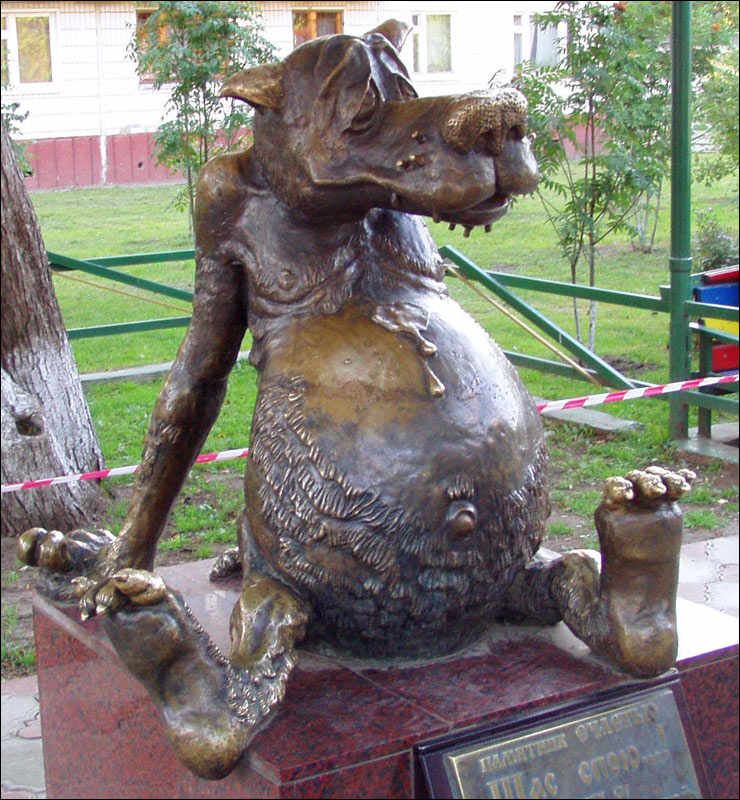
Monument to Happiness - one of the most original monuments of Tomsk. It is a bronze figure of a full, extremely pleased, and impudent wolf from the great Soviet cartoon “Once upon a time there was a dog”. Shevchenko Street, 19/1.
Epiphany Cathedral (1777-1784) - one of the oldest churches in Tomsk. This magnificent building constructed in the Siberian Baroque style is located in the very heart of Tomsk. Lenin Square, 7.
White Mosque (1914) - a majestic building constructed in the neo-Moorish style with stone carvings, lancet windows, and doors. Lugovoy Lane, 18.
Siberian Botanical Garden. The garden covers a huge area, more than 120 hectares. There are almost 8 thousand species of plants here including tropical and subtropical. Most of the trees, shrubs, and flowers can be found outdoors. Its grandiose greenhouse is one of the largest and highest in the world. Lenin Avenue, 34/1.
Picturesque architectural monuments of Tomsk:
- “House with Firebirds” (1890) - a fine example of wooden architecture built by the merchant Zhelyabo as a wedding gift to his daughter, an architectural monument of federal significance (Krasnoarmeyskaya st., 67/1),
- “House with Dragons” - one of the symbols of Tomsk with 7 bizarre carved dragons (Krasnoarmeyskaya Street, 68),
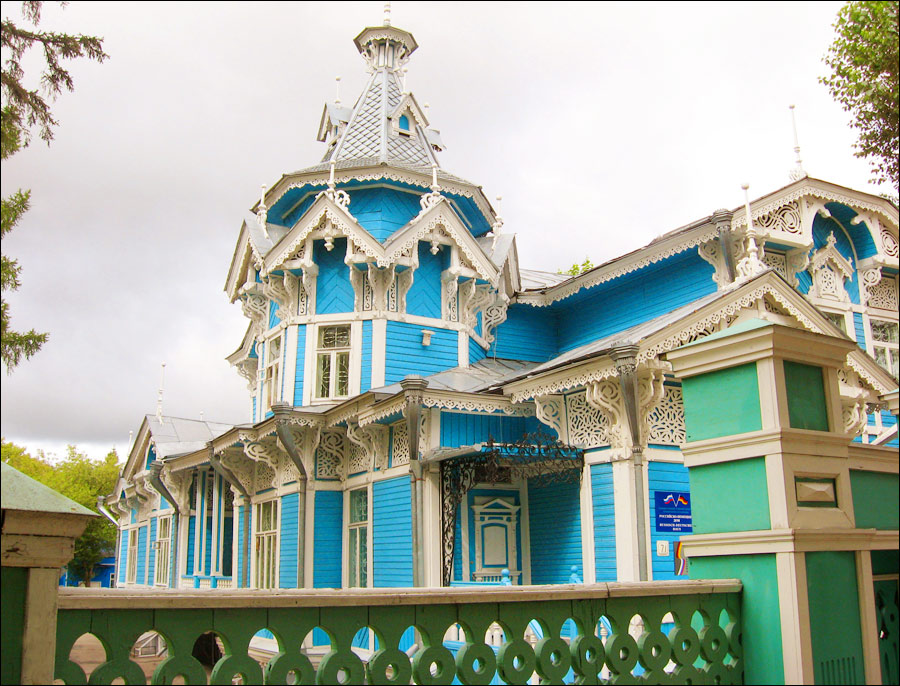
- “House with a Hipped Roof”, also known as the Tomsk Regional Russian-German House - an elegant mansion built at the beginning of the 20th century for the wealthy merchant G.M. Golovanov, a masterpiece of wooden architecture not only in Tomsk, but throughout Siberia (Krasnoarmeyskaya st., 71),
- The mansion of the architect S.V. Khomich (1904) - the architecture of this building is so eclectic that it rather resembles a fabulous gingerbread house (Belinsky, 19),
- Tomsk State University - this building of the oldest university in Siberia, founded in 1888, is one of the most recognizable symbols of Tomsk (Lenin Avenue, 36),
- Garrison House of Officers named after N.N. Yakovlev - a beautiful brick building with original decor (Lenin Avenue, 50),
- Tomsk City Hall (1899) - an eclectic three-story mansion built of red brick and light sandstone located in the city center (Lenin Avenue, 73),
- The estate of I.D. Astashev (1842) - a magnificent palace that once belonged to the gold miner Astashev, one of the most beautiful buildings in Tomsk (Lenin Avenue, 75).